If someone were to dive deep into the Arabian Sea today, past the dancing waves, the bustling surface life, and the shifting light, they would eventually reach a quiet world. A world where tiny grains of mud, dust, and silt slowly fall and settle like silent storytellers. Beneath the water, these grains accumulate layer by layer, year after year, century after century. Most people never think about these layers. But hidden inside them is an extraordinary record: a diary of Earth’s climate, written not in words but in sediments. This story is about one such diary.
The Ocean FloorTime Machine
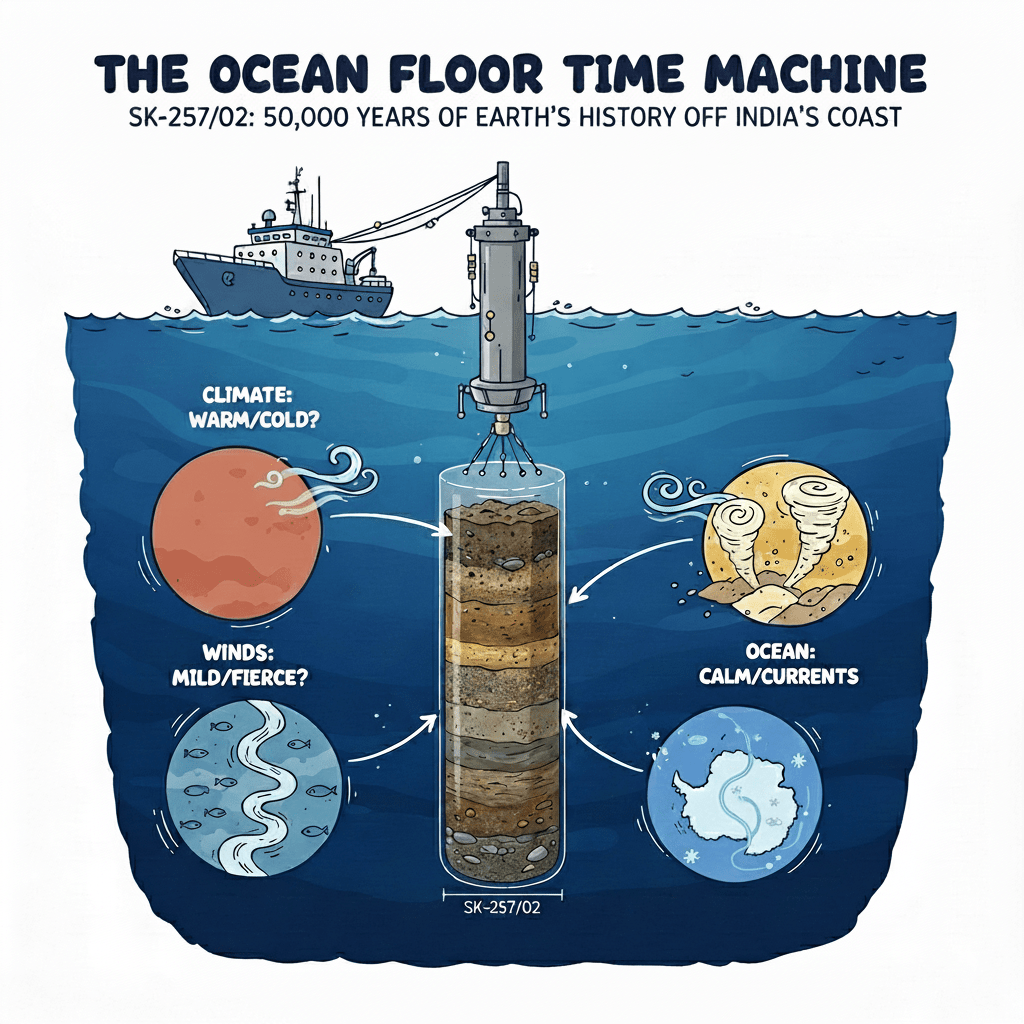
About 200 kilometres off the southwest coast of India, in the southeastern Arabian Sea, a research team lowered a long steel barrel to a depth of 1.64 kilometres below the sea surface. When they pulled it back up, it carried a 4.4-metre-long sediment core, almost like a layered cake, recording environmental changes stretching back nearly 50,000 years. This core named SK-257/02 became the centrepiece of a detective story that blends monsoons, dust storms, rivers, and even faraway Antarctic waters.
Each centimetres represented decades of Earth’s history. Each grain whispered clues:
Was the climate warm or cold?
Did the monsoon roar or weaken?
Were the winds mild or fierce?
Was the deep ocean calm or pulsing with strong currents?
Two monsoons, Two personalities
In general, India’s climate is shaped by two very different monsoons:
The Southwest Monsoon (SWM): the summer rains that fill rivers, cause floods, and feed crops.
The Northeast Monsoon (NEM): the winter winds that blow dry air and kick up dust.
These monsoons don’t just shape life on land but they influence what reaches the sea floor. During strong summer monsoons, swollen rivers wash huge amounts of clay and fine mud into the ocean. During dry winters, powerful winds sweep deserts in Arabia, Africa, and India, carrying dust far over the sea. Over thousands of years, these seasonal rhythms leave behind alternating layers of river-borne mud and wind-blown dust.
The three characters in the sediment
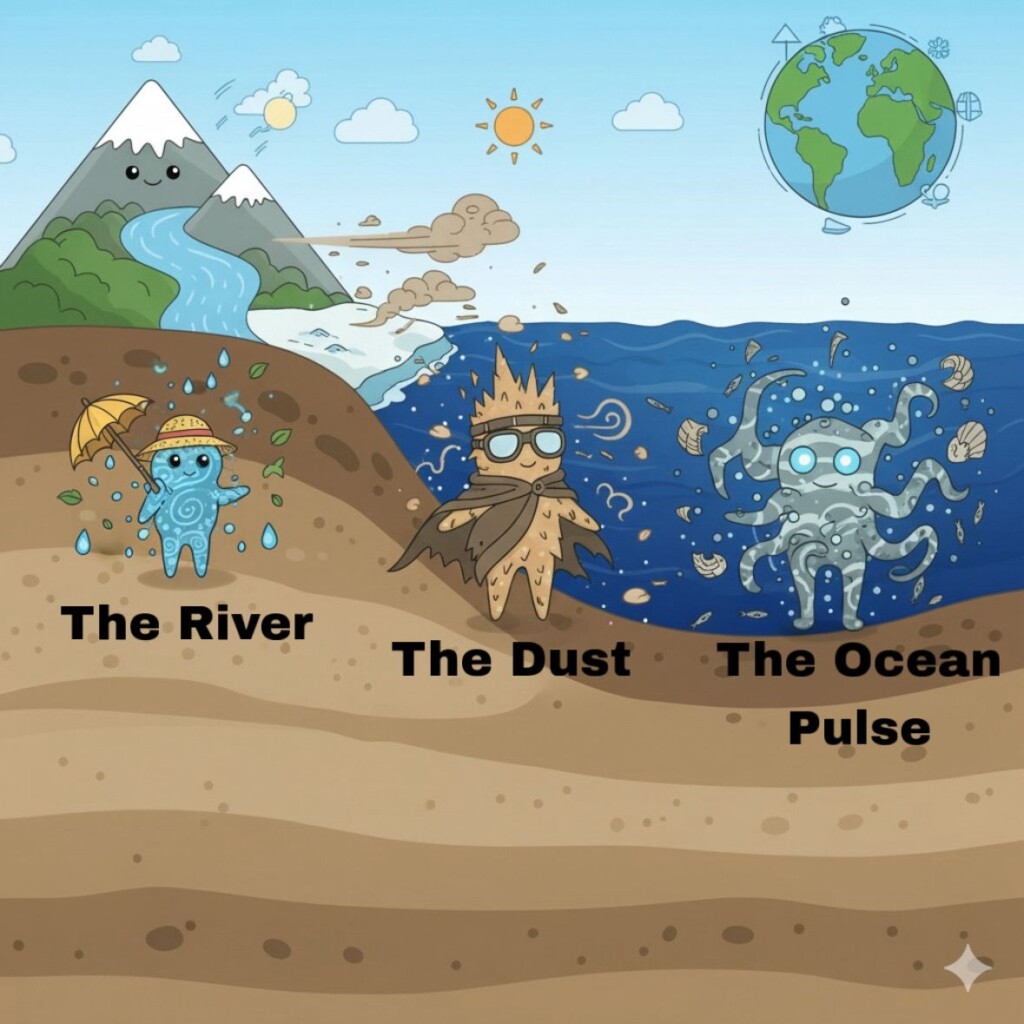
When the scientists analyzed grain sizes in the sediment, they discovered three distinct “personalities “or end members (EM):
EM1 : The River’s Whisper
Tiny grains of clay and very fine silt. These only reach the ocean when summer monsoon rains are strong, washing soil off the land and carrying it out to sea.
EM2: The Dusty Traveler
Slightly larger grains-wind-blown silt. These arrive when winter monsoon winds strengthen, especially during cold, dry ice-age conditions.
3. EM3: The Ocean’s Pulse
Medium-sized silt grains. These don’t come from land. Instead, they appear when deep ocean currents become strong, stirring up old sediments and resuspending them like underwater dust storms. Together, these three characters reveal how Earth’s climate has swung back and forth across ice ages, warm periods, and dramatic global events.
What the mud said about the last 50,000 years ?
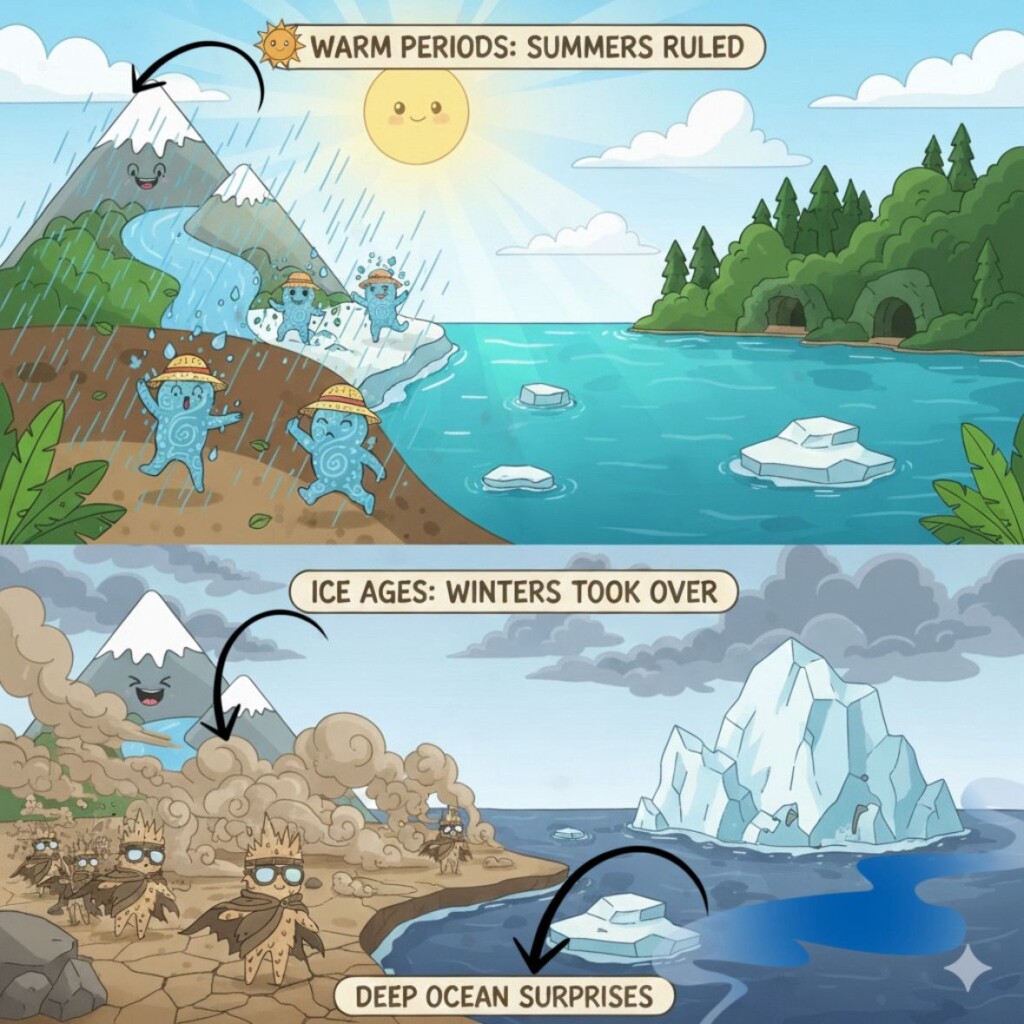
Warm Periods: Summers Ruled
During warmer climates like today and around 40,000–50,000 years ago the clay-rich EM1 was abundant.
This told the researchers:
Summer monsoons were strong.
Rivers carried fine mud into the sea.
Rainfall was abundant over the Indian subcontinent.
These dusty layers were like fingerprints of ancient windstorms crossing continents.
Ice Ages: Winters Took Over
During the Last Glacial Maximum (about 21,000 years ago), the dust-rich EM2 took center stage:
Winters were harsh and dry. Deserts expanded.
Strong winds blew more dust into the Arabian Sea.
Summer monsoons weakened drastically.
The sea was cooler, and rainfall over India was much reduced.
These dusty layers were like fingerprints of ancient windstorms crossing continents.
Deep Ocean Surprises
The third type of grain EM3 revealed something astonishing. These layers increased during:
Glacial times Heinrich events (massive iceberg breakdowns in the North Atlantic)
Younger Dryas (a sudden cold spell 12,000 years ago)
Because when the Northern Hemisphere cooled, deep ocean circulation patterns shifted. Stronger pulses of cold, nutrient-rich Antarctic and Pacific waters surged northward, stirring up the sea floor at 1600–2000 meters depth. In other words, the sediments showed a teleconnection a climate bridge linking the Indian Ocean with the North Atlantic and Antarctic.
A Global
Climate Symphony
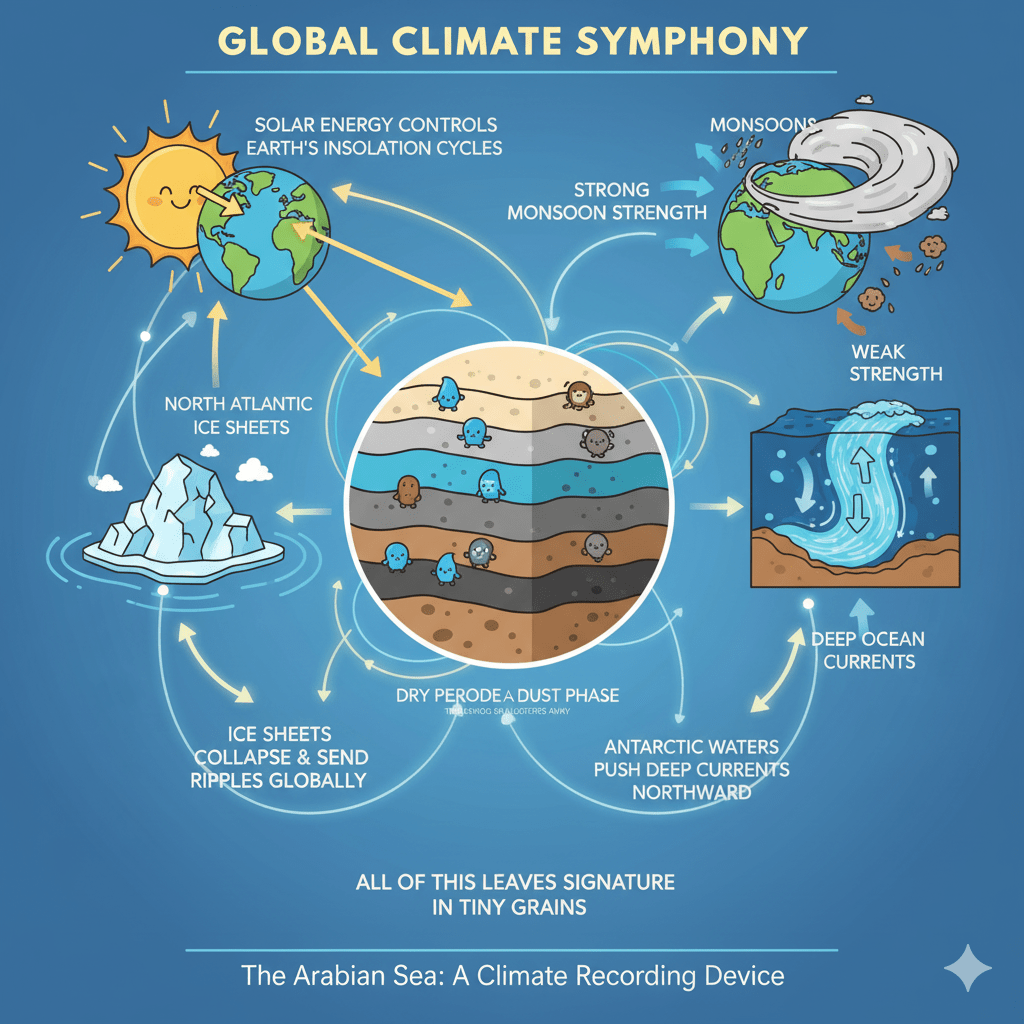
The story that emerges is not just about India or the Arabian Sea. It is about a planet whose systems are interconnected:
Solar energy controls Earth’s insolation cycles.
This drives monsoon strength. Faraway ice sheets in the North Atlantic collapse and send ripples across the globe.
Antarctic waters respond, pushing deep currents northward.
All of this leaves a signature in tiny grains of sediments thousands of kilometers away. The Arabian Sea, it turns out, is like a giant climate recording device quietly archiving global change.
Why This Story Matter ?
Understanding the past is the best way to understand the future. By decoding these sediments, the research shows: Monsoons are extremely sensitive to global climate shifts. Dust levels, rainfall, and deep ocean currents respond to even small changes. The Arabian Sea mirrors global climate pulses from the poles to the tropics. As our world warms today, these ancient records help scientists predict how the monsoon and ocean circulation might behave in the coming centuries. In the End, the Sediments Speaks, fifty thousand years of history sat silently at the bottom of the sea until a team of scientists listened. They uncovered a story of rivers and winds, ice ages and warm periods, deep currents and distant oceans each chapter written by grains so small they seem insignificant. Yet together, they form one of the most powerful climate narratives of our region.