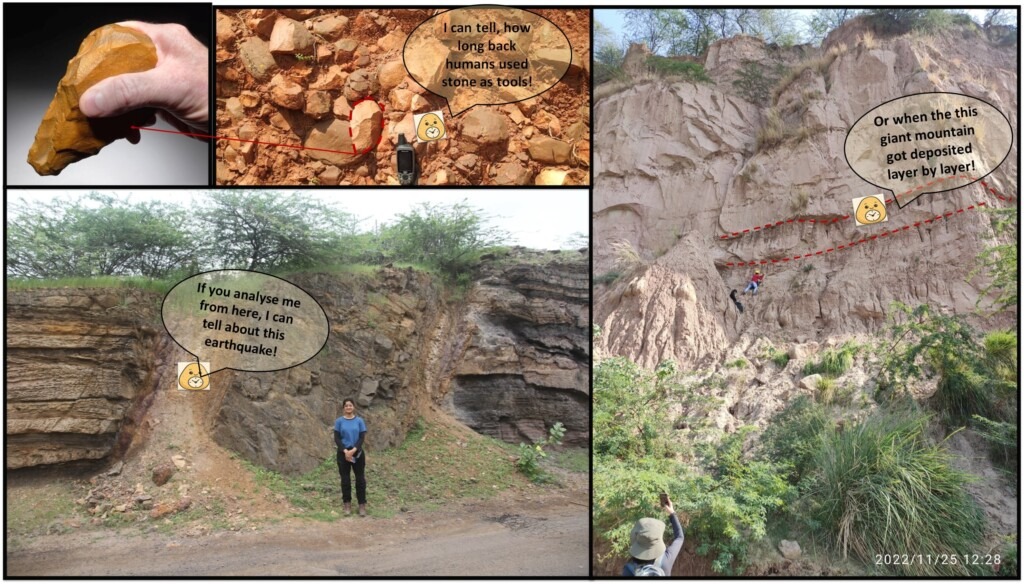
An important aspect when we try to learn about our past, and understand the sequence of different events, is the time when a particular event has occurred. Our history books are full of dates of such events. Dates that tell us when humans first used stones as tools, when humans started using metals for making ornaments and weapons, when the ancient civilization thrived, or even when mighty rivers dried up or changed their paths. It is important to know when natural hazards such as volcanic eruptions, earthquakes, floods, tsunamis etc occurred in past or to know the interval of occurance of such events.
Knowing about these events with their timing helps us understand our past and prepare for the future.
But guess what? Who tells the timing of these events to the history books?
Of course, scientist! But how do they know these times?
There are some inherent clocks built by nature which tell us about these times.
In one of our past issues (Article 03) we discussed about Carbon-14 (C-14) dating method. Another such widely used method is Luminescence dating.
In C-14 dating method, scientist need the carbon for estimating ages, but for luminescence dating they use sand, which can be found almost everywhere.
Luminescence Dating
Scientists analyse the sand grains that has witnessed and had been a part of these events. Sand grains know these stories!
Each grain of sand has travelled through desserts, oceans, rivers, glaciers by winds or water. They have witnessed climate changes, earthquakes, floods, human rise and fall. And amazingly, they carry a hidden record of these events, waiting for us to read it.
How does Luminescence Dating work?
Think of it like a clocklock. like a clock.
Your wall clock tells you the time of day.
Luminescence dating tells scientists the “time” of natural events- that happened a few years ago up to about 500,000 years back! Historically, Earth has seen major climate changes, ice ages, and life form evolution in this time period!
For this clock to work, two things are important:
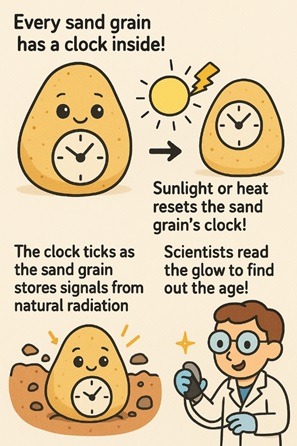
Resetting to zero
Just like we reset a stopwatch before starting, sand grains also have their clocks reset. This happens when they are exposed to bright sunlight, strong moonlight, or high temperature (for example, when pottery is baked in a kiln, when sand heats during an earthquake, or when lightning strikes sand). The grains forget their previous journey.
Ticking of clock
Inside each sand grain, there are tiny imperfections forming traps of charged particles (or storage of light). These traps can catch electrons generated due to radioactivity present in sediment and store them (which means they store energy which can be released as luminescence). The longer a grain stays buried without light or heat, the more electrons/energy it stores-like a battery slowly charges over time.
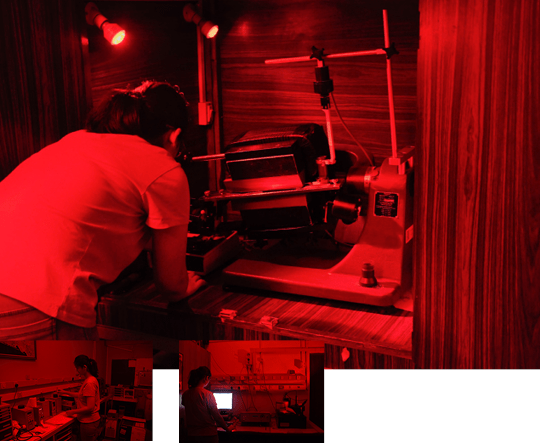
The sand grains having the stored charges (or light) are brought in light tight pipes from the field. Scientists separate specific minerals like quartz and feldspar present in this sand to measure the luminescence. As a result, it involves rigorous chemical and physical methods followed by measurements. As the stored charges are sensitive to light and can reset on exposure, all these procedures and measurements have to be done in the dark. This restricts scientists to working in subdued red-light labs, as red light has the lowest energy. On measurement, grains emit light called luminescence. Brighter the luminescence, older the sample. Alongside measuring the amount of natural radioactivity of soil, scientist can calculate how much luminescence is stored per year in sand grain. By knowing total luminescence and annual rate of luminescence storage, they can calculate the age of sand grain, i.e. when its clock was last reset by heat or by light, which happened due to an event in which we are interested. Hence, telling us about the time of the event.
So the next time you see sand on a beach, or rocks on mountains, remember: every little grain might be holding a piece of Earth’s history, just waiting to tell its story.